Showing posts with label ABA Reform. Show all posts


I have been presenting/speaking, writing, and training on the topic of ABA Reform/anti-ABA sentiments for some time now. I have spent time engaging in intentional community and dialogue with people who disagree with ABA, and even have traumatic experiences from therapy services (some which really should never have been called “ABA”), as well as doing the work daily in my sphere of influence to train up/mentor/coach supervisees on this topic. Lots of listening, closing my mouth, being open to changing my own mind, being open to critique and feedback, and letting people tell their own stories.


I’m not alone in this. I know many ABA clinicians and providers who are also moving away from defensiveness and being closed off to criticism or shutting down Autistic voices because they disagree with ABA. I know people personally who have completely changed the way they practice, and I have mentors in this field that I look up to who have helped model for me the way forward, towards a more compassionate and respectful ABA. There is still lots of work to be done, and I know many providers committed to doing that work, every day, across all their clients.


However—


I get lots of comments, questions, and emails, from anti-ABA people who want me to do more. They want me to close up shop, rip up my certification, terminate all my client contracts, and find something else to do. They want ABA to just go away. Reform isn’t enough, changed mindsets isn’t enough, and listening to the Autistic community isn’t enough.


To that, I want to openly and publicly say: I respect your point of view, and I’m not here to tell people what to think. You have formed an opinion and are 100% convinced it is correct.  You believe ABA is conversion therapy, it is abuse, it is terrible, and that any ABA provider must therefore be terrible. You aren’t interested in dialogue or collaboration, you want ABA providers to shut up, and go away.


I hear you.


But I’m committed to change. For myself, for those professionals within my sphere of influence, for the clients and the client families I support and work with every day, and for the field in general, as far as my own advocacy and activism will allow. I speak out regularly about better ways to do ABA, issues with this field/industry, and the need to better support clinicians, and better train Technicians. I feel strongly about ALL of these issues.


To Autistics I say: keep speaking up and keep speaking out. Yes, you will find that trying to dialogue with some ABA providers or company owners will be an exercise in futility. But, there are those of us out here who WILL listen. Who won’t shut you down, who are willing and interested in engaging in respectful communication and truly want to learn. We are here.


You may not want to speak to us, you may not want to dialogue with us, and you may not want us to continue supporting individuals and families, but again: We are here. We will remain here, and we will commit to growth, own up to our mistakes, and stop acting like we know it all. We don’t know all. No one knows all.


So for those who ARE interested in learning, growing, communication, collaboration, and improving the quality and soul of ABA services: We are here.


Let’s work together.


** Recommended Reading:

What is ABA/Can it be Reformed?

Toward ABA Reform

A Perspective on Todays ABA

https://www.iloveaba.com/2020/11/aba-haters-pt-ii.html

https://www.iloveaba.com/2021/08/trauma-informed-aba.html

https://www.iloveaba.com/2018/03/normalization.html

ABA Reform Movement podcast episode

List of ABA Facebook Groups

Toward Trauma Informed Applications of Behavior Analysis 

What is Trauma Informed ABA podcast episode

Taylor, B. A., LeBlanc, L. A., & Nosik, M. R. (2018). Compassionate Care in Behavior Analytic Treatment: Can Outcomes be Enhanced by Attending to Relationships with Caregivers?. Behavior analysis in practice12(3)

Compassionate Care in ABA


 Recommended Read: Toxic Staff 


If toxic staff is 1/2 of the conversation about what creates and perpetuates sick, dysfunctional work culture, then toxic leadership is definitely the other 1/2 of the conversation. You can't discuss one without discussing the other.

Unhealthy work demands, narcissistic managers, unrealistic productivity metrics, all of these contribute to the "revolving door" staffing issues that many, many ABA companies face.


Who is at the top? Who is getting promoted to the top (and who isn't)? And what characteristics and concerning behaviors do those in leadership consistently exhibit?


Examples? Sure:

Employees who sacrifice/neglect their OWN families to work long nights and weekends for clients are seen as “go getters” and “customer satisfaction focused”

A lot of hype and focus is placed on giving “110% every day”, with little discussion about how that is also the definition of burn out culture

Leadership decisions are not to be questioned. They are to be accepted. Questioning or disagreeing leads to the employee being seen as "insubordinate", "disrespectful", or "problematic"

“Hit the ground running” is a euphemism used to communicate the expectation that you will jump headfirst into a project or assignment and not bother anyone with questions, or requests for assistance

“Soft skills” like compassion, empathy, or person-centered treatment is retwisted as being “too soft”, “too emotional”, or just weak. You are encouraged to be firmer with clients, “convince” families of hours they don’t want, and project “confidence”


And on and on and on. 

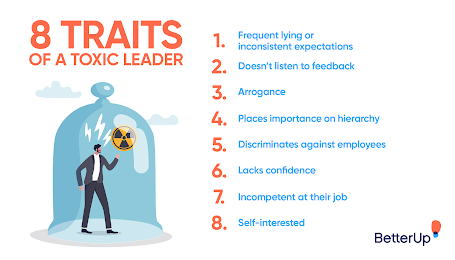
Source: www.betterup.com 


Toxic leaders create and worsen toxic work cultures, resulting in staff who are timid, fearful for their jobs, indecisive/do not trust their ability to be a self-directed employee, and hesitant to provide constructive feedback. These are not fun places to work, and the work being produced typically reflects that.

Taking that a step further, what happens when people working in a field intended to help, support, coach, teach, or instruct vulnerable populations, is suffering under toxic leadership? What is the impact on quality of care and client outcomes? I don't think this is a question of "Will this affect the clients", but a question of "How will this affect the clients".

If the point of a leader in a company is to guide, instruct, and lead those under you, then following a toxic leader is like walking on a circular road that doesn't go anywhere. Its a pointless exercise in futility, and a good way to ignite a great resignation


In my latest book, 'The Practical ABA Practitioner', I talk at length about my experiences in this field working for toxic owners/managers. The way those experiences impacted my job satisfaction, my passion for Behavior Analysis, and my emotional and mental health (burnout, anyone?). My experience is not unique. Employees: talk to your colleagues. How many of them have sat under toxic leaders, and what impact did that have on them? Employers: talk to your team. How many of them view their current managers or supervisors as toxic, and how does that impact their day-to-day work?

Dangerous leaders are not just dangerous because of their pathological mindset and questionable behavior. They are dangerous because they expect the people under them to become like them. To focus on profits over people, to "hustle hard"/work until they drop, and to prioritize company health over their own mental health. 


When we examine the rates of position resignation in this field, as well as clinician burnout, how much of that is caused by toxic leadership? Many companies have systems and procedures in place that can actually encourage professional burnout. When employees feel isolated from colleagues and distant from ownership/management (silo mentality), or when unrealistic caseload expectations are presented as being non-optional, staff will try to rely on their smarts and training to get them through these challenges. But sometimes, it isn't the staff that needs to change, it's the system that needs to change.

 How well does the employer evaluate staff for signs of professional burnout? Are boundaries or guardrails put in place so that staff are not experiencing excessive driving, highly variable scheduling, regularly dealing with highly challenging consumers, or working 12 hour days 6-7 days a week? Does the work culture intentionally promote cooperation, teamwork, and open communication? Can staff  directly access management to voice complaints, or even just vent? Or, do staff know that complaining about people higher up than them will lead to swift retaliation? All of these issues can lead to staff who feel devalued and unappreciated on a regular basis.


It takes healthy, rested, emotionally stable people to perform the challenging work of supporting vulnerable populations through behavior analytic interventions in the community, home, and classroom. Toxic work cultures don't only impact your team, they also impact the very clients you are supposed to be helping.

Source: www.hcamag.com 


** More Info:

Preventing Burnout 

Lipman-Blumen J. (2010) Toxic Leadership: A Conceptual Framework. In: Bournois F., Duval-Hamel J., Roussillon S., Scaringella JL. (eds) Handbook of Top Management Teams. Palgrave Macmillan, London.

What is Ethical Leadership?

Developing Leadership in Your ABA Team

Esquierdo-Leal, J.L., Houmanfar, R.A. Creating Inclusive and Equitable Cultural Practices by Linking Leadership to Systemic Change. Behav Analysis Practice 14, 499–512 (2021).

A New Model for Ethical Leadership 


Today's quote is from...me! From a recent podcast interview with Dr. Mary Barbera:

"Good ABA start with parents. So, for any parent or caregiver, if you are trying to determine a quality place for your child to receive ABA services, you really have to start by looking at what's the goal of intervention. I really feel like that's like the foundational first step, because if you are speaking with a company or a provider and they're talking about: 'We're going to fix this, we're going to correct blank, we're going to make your child more.../ We're going to remove stigma',  and other words like that, all of those words are getting at normalization. Which should not be the goal. The goal should not be to magically make it as if your child were born differently. The goal should be to give the client as many supports as needed to contact the things they to need to contact in life. For example, letting people know when you want food, using the bathroom,  attending school, etc., because in certain parts of the world children with disabilities don't attend school. So, we really have to look at what this means for the client and removing barriers to being able to do different things in their life. And then we address each barrier one by one. That should be the goal of ABA. 'We're going to help your child do _____/We're going to make it easier for your child to do ____". That should be the kind of language that is being said by a provider, or by a company.  It should be very, very concerning when you are contacting an ABA provider saying you need help and that provider is instead telling you, 'Here's what we're going to do', and they're not listening to you and they're not taking your input and they're just saying, 'Oh, yeah, yeah, we know what to do. We know autistic kids. Here's the standard protocol. Here's the strategy'. No, that is not how that should work. Absolutely not."


Good ABA services are a must for some people. Yes, people. Not just small children.

It can be a must for disabilities beyond Autism.

It can be a must inside of the classroom.

It can be a must in adult day programs and residential settings.

It can be a must when harmful, destructive, violent problem behaviors are serving as a barrier to least restrictive settings and placements.


ABA intervention at its core, is about teaching new skills and removing barriers that get in the way of learning and being successful in life. NOT a push for normalization.

Quality intervention that is generalized across caregivers and settings, can bring about amazing long-term success and developmental gains.


Take a listen HERE for more tips on distinguishing between good & bad ABA providers.


"...They discovered that many of the challenges they face daily are not "symptoms" of their Autism, but hardships imposed by a society that refuses to make basic accommodations for people with cognitive disabilities as it does for people with physical disabilities such as blindness and deafness"

"There seemed to be so little information available about raising kids on the spectrum that didn't view Autism as the principal problem to be surmounted, rather than tackling the practical barriers that stood in the way of fulfilling their potential"

'NeuroTribes' by Steve Silberman


Autism is a disability, and a gift. It is a vast spectrum, where the challenges and unique talents are dispersed unevenly, uniquely, and entirely heterogeneously from one person to the next.

For this very reason, it can be insanely difficult to find appropriate resources, therapies/interventions, medication protocols, schools & college programs, or job placements "for" Autistics. What works for one Autistic, will be 100% nonhelpful for a different Autistic. An amazing private school program that serves highly verbal and autonomous Autistic children, would likely be a terrible fit for Autistic children who do not communicate by speaking, are not toilet trained, and engage in self-harming behaviors. Oh, and also the level of support that is successful THIS year, could be too much or not enough come next year.

This is not paint-by-numbers. There is no magic solution.

We must do the hard work, every day, to provide compassionate, individualized, and dignity respecting care and support to the Autistic children, teens, and adults in our life.

No shortcuts.

 Recommended Reading: What is the ABA Reform Movement (ABA Haters Pt. II)?


You may be a caregiver, professional, teacher, or someone simply interested in ABA as you read this.


Regardless of how connected you are to the ABA community, you might not be aware of ABA Reform, what it is, why it is needed, and changes that are being made, right now, in both large and small ways.


In case you are unaware, let me walk you through the ongoing conversation a bit. It will help shed some light on why "Trauma Informed ABA" is a thing, and why it’s a much-needed thing:


Both within and outside of the professional ABA community, there are people who want to see ABA adapt, listen more to the very populations we serve, reflect on our past (and sometimes current) practices, grow, learn, and in general: Evolve. The way to bring about this change does differ, with some people wanting ABA therapy to end/be abolished, some people wanting to see wide, sweeping change at the top levels of the field, and other people believing that practitioners doing their job differently everyday, in small and impactful ways is how we accomplish change. Different people have different perspectives, so it makes perfect sense to me that although many people are talking about changing and improving ABA therapy, there is little consensus on just how to do that.


So how does this connect to trauma informed ABA?


Trauma Informed ABA can be operationally defined as recognizing that someone's history, lived experience through their own eyes, and mistreatment or microaggressions has a direct impact on how they behave. It is viewing someone through the context of who they are in the world, and how they self-identify OR are identified or labeled by others. For example, a history of abuse, crisis event, significant illness or injury, neglect, mistreatment, prejudice, misjudgment, or social rejection, are all traumatic events that should influence how any intervention or therapy is applied and carried out.


In a nutshell, trauma informed ABA is an intentional decision to provide services and care in a highly personalized, unique, person-respecting manner, and to recognize that we are all products of our environment. For good, or for bad.


If you are an ABA professional, you may be thinking "Well....obviously. I already do this in my practice". I'd invite you to dig a little deeper and consider some of the strategies and techniques you implement through the lens of your client (put yourself in their shoes).

For example, I've worked with many young children who have been kicked out/asked to leave multiple daycares or preschool settings before I ever met them. How did those experiences affect them? What must it have felt like to be in a setting where you are excluded, not wanted, misjudged, and your needs weren't met? What kind of interventions and consequences to problem behavior were attempted before the facility realized they could not meet the child's needs? How did those failed attempts at consequences make that child feel? But here is the problem: for most of the clients I serve, I cannot just ask them these questions. Even if they communicate by speaking, they don't always have the vocabulary, cognitive understanding, or desire/motivation to answer these kind of questions. And of course, asking someone's caregiver or parent to speak on the client’s traumatic experience is not quite the same as asking the person who lived through it. Is it starting to sink in now??


As ABA professionals, we must approach each client uniquely and specifically, meaning we make little assumption from one client to the next. We modify and tailor intervention to what the client needs and prefers, not what we think is best or should happen. We collaborate with caregivers, parents, and other professionals working with that client, and we design intervention in a way that respects client dignity, autonomy, choice, and again: preferences. If my client hates washing dishes, is it unethical to utilize reinforcement to teach them this skill because their parents want them to wash dishes? If my client has a meltdown in a public space, should I immediately take them out to respect their dignity in that moment or is that "reinforcing escape behaviors"? If my client is non-compliant, is physical prompting necessary? How do I respond during a session when my client revokes their assent? What about a client who is older or able to communicate, and tells me they don’t want to receive ABA therapy. How should I respond? How do I select treatment goals for a client who has no means to communicate? How do I make sure I am embedding client choice? Is it ethical to create a Behavior Plan for stereotypy? What about teaching play skills? Is this ethical or not?


These are not easy questions to answer, which is the whole point.

For client A who has a very specific background, I may answer these questions one way. But then with client B who has a history of trauma, school refusal/aversion to authority figures, or past experiences with a low-quality ABA provider, my answers could be completely different. And that is how this should work, with the intervention package looking quite different from one person to the next. That’s a GOOD thing.

 If the care being provided is individualized, focused on what is best for that individual (and not just their caregivers/parents), and trauma informed, then the intervention will ultimately be far more helpful, impactful, and SAFER/less harmful to the individual receiving therapy services.


There's tons of valuable information, research, and resources about trauma informed ABA (here is a massive list of resources). I urge any ABA professional reading this to dig into this methodology and embed it into the way you do your job. Listen to Autistics who speak about their life experiences, meltdowns, sensory issues, and their daily challenges. I have worked with many Autistic RBTs or BCBAs, and learned so much from them talking about their own experiences as a child, in school, in therapy, as an adult, etc.

 In order to gain new perspective, you have to be willing to be wrong. Be willing to say "Wow, I didn't know that", “I don’t know/I need to research that further”, or "I never thought it about that way". This how we learn.


There is a movement happening all around us, and while it may have many differing voices, that does not negate the need for change. We CAN do better at how we help our clients, how we listen to our clients (especially those who do not communicate by speaking), and how we serve the disabled community.


*Check out these great resources to learn more:


Trauma Informed Behaviorism 

Trauma Informed Care for Behavior Analysts 

'What is Trauma Informed ABA?'

A Perspective on Today's ABA (Dr Hanley)

ABA Provider Listening Pledge (video)

The Compatibility of ABA & Trauma Informed Practice

Examining Challenging Behaviors from a Trauma Lens

Parent perspective on the importance of listening to Autistic voices


"Ableism is perhaps the single most important disability-related keyword that exists besides the term 'disability' itself. It represents one of the biggest obstacles that people with disabilities face, and yet the word is not very well-known outside the disability community. If you don’t know this word already, it is a must-have in your vocabulary."

"What is Ableism & How can you be Anti-Ableist?" by Jill Feder


Ableism can be defined as various forms of negative biases and discrimination that people can face because of their actual or presumed disability


It is important to check our own biases, misconceptions, and assumptions when it comes to the individuals we support, teach, train, and work with.

None of us are exempt from this conversation, because even if you may say "Well, I certainly don't have any negative biases or perceptions about Autism", what do you when you confront them at work? Or in the school where you teach? Or if you are raising an Autistic child, hear from your own family members? How do you respond, or DO you respond?


Here are some great examples of ways in which disabled children, adolescents, and adults may face Ableism in their day-to-day life. 

Seeing the problem (awareness), is the 1st step towards standing up to address it or call it out when it happens:

Patronizing language or Infantilizing Autistic adults

"Obsessions/Fixations" instead of "Special Interests"

Person- first language when Identity -first language is preferred

Functioning labels (i.e. low functioning)

Approaching your clients with a "Fix it" mentality, vs a "Support & Assist" mentality

Assuming non-vocal/non-speaking means "cognitive impairment"

Only speaking of Autism as a burden

Over-prescribing therapy or intervention with the goal of Normalization

Teaching "passing" or "masking", instead of person-focused intervention

Talk of "recovery" or a "cure"


Source: Avoiding Ableist language in Autism research

 Recommended Reading (seriously, go read this now): Autism & ABA & A$$holes


ABA peeps: Do you want to be a good Behavior Analyst? Or a Great Behavior Analyst?


'Behavioral Artistry' as described and defined in the 2019 Kevin Callahan et al. article, is the difference between being a practitioner following learned "recipes" or paint-by-number strategies, and a creative, passionate clinician, qualitatively better at their job.

We know the process of obtaining the BCBA credential: verified coursework, hands-on practical supervised experience, and passing a rigorous exam (www.Bacb.com). Completing these steps to satisfaction will yield a BCBA.

But will that BCBA be....pleasant? Professional? Funny? Warm? Engaging? Enjoyable to work for? Caring? Empathetic? Socially Mature? 


Does it matter what we know (skillset), if the experience of working with us/for us is terrible?

I'm going to answer for everyone and say: No.


If you have been working in this field for some time and have not come across the stereotypical "cold, robotic" BCBA, then how exciting for you. Unfortunately, your experience of not working for or with this type of person does not deny their existence. I have worked for quite a few arrogant, rude, empathy-deficient BCBA's, and have also helped fellow BCBA's (and myself) to self-correct when that good ole' bedside manner needs a realignment.

This is a problem.

It's a problem because BCBA's most often fulfill a role focused on people, and socially valid behavior change. People need to like us, in order for services to be most effective. People need to listen to what we have to say, value our recommendations, and trust our data in order to yield any results.


As a BCBA, do your supervisees enjoy working for you? Are they having a pleasant experience being supervised by you? Do your clients enjoy seeing you show up at their school, home, or clinic? Do the client parents or families enjoy working with you? What about your colleagues, the leadership over you, or other professionals you interact with to do your job (educators, SLP's, OT's, physicians, etc.)? Beyond data sheets, reports, and graphs, what is the qualitative experience people have when they encounter you at work?


Basically, the big question here is: **What are the behaviors that make some BCBA's better than others?**

The concept of Behavioral Artistry was developed out of a need to address the interpersonal behaviors of Behavior Analysts (which ones are most needed? what happens when they are lacking?), and directly tie those behaviors to clinical outcomes. In case you missed that---> insufficient interpersonal skills can have negative impacts on treatment delivery, and client success. See why this topic is so important? 


BCBA's with better interpersonal skills (as measured by specific behavioral characteristics), LOOK better when doing the job. They laugh more, they smile more, they pay attention better, they listen more carefully, they are more objective, they are more creative, they are optimistic, they are persistent, and other people have a better experience working with them. 

I always find it so odd that in a role where many of us are working to help our clients be more flexible (Super Flex, anyone??), as BCBA's we can be some of the most rigid and inflexible clinicians, when compared to other disciplines. Why is that? Who exactly does that benefit??


In 2016 Leaf and colleagues examined the pervasive use of ABA in autism treatment, and pondered ways behavioral interventions could become less effective:

"A danger inherent in any large scale, quickly growing area is a loss of focus on meaningful purpose, process, and outcomes. In the field of ABA, this might translate into dogmatic lack of attention to clinical significance, selection of impractical procedures, ritualistic data-collection, over-abundant use of off-putting, dehumanizing terminology, disregard of logistical realities, and insensitivity to consumer issues"

 Any part of this quote sound familiar? Or like anything you've experienced at work? Particularly in the current climate of the ABA industry, where Big Business can be more focused on profit than quality.


Behavioral Artists are best viewed as organically talented BCBA's (meaning their greatness is more about who they are, than what they know)  who consistently demonstrate specific interpersonal characteristics such as the following:

  • Likes people: is able to establish rapport; demonstrates concern; wants to facilitate positive change;

  • Has “perceptive sensitivity”: pays careful attention to important indicators of client behavior that may be small, subtle, and gradual;

  • Doesn’t like to fail: sees difficult clients as a personal challenge to overcome, and as an opportunity for the client to succeed;

  • Has a sense of humor: recognizes and accepts that much in the educational and human services professions is bizarre, illogical, and humorous;

  • Looks “for the pony”: is optimistic and sees behavior change in a “glass half-full” context; always believes programming will be successful; is less likely to burn out;

  • Is thick-skinned: doesn’t take negative client actions towards herself or himself personally; maintains objectivity and positivity; and

  • Is “self-actualized”: does whatever is necessary and appropriate to facilitate and produce positive behavior change; is not under audience control; is creative


If we want to be great clinicians (which...… why wouldn't we want to be great?), then the measuring stick used needs to go far beyond goals mastered, assessment grids completed, and billable hour quotas met. Productivity does not equal excellent interpersonal skills.

The measuring stick used must include qualitative measures, such as client feedback, supervisee feedback, warmth, and compassion.


References:

Callahan, K., Foxx, R. M., Swierczynski, A., Aerts, X., Mehta, S., McComb, M. E., Nichols, S. M., Segal, G., Donald, A., & Sharma, R. (2019). Behavioral Artistry: Examining the Relationship Between the Interpersonal Skills and Effective Practice Repertoires of Applied Behavior Analysis Practitioners. Journal of autism and developmental disorders49(9), 3557–3570


Leaf JB, Leaf R, McEachin J, Taubman M, Rosales S, Ross RK, et al. Applied behavior analysis is a science and therefore, progressiveJournal of Autism and Developmental Disorders. 2016;46:720–731.


Are All BCBA's Robots or Just Mine?


Providing Compassionate Care 


A current criticism of the ABA field/industry is that as more and more investors come in, expand existing companies, and open new and large, multi-state companies, quality assurance is decreasing.


How are we intentionally and systematically evaluating the effectiveness of treatment, client outcomes, and individual client response to intervention? Not just at a large, across clients level, but for each individual case/client/treatment plan (e.g. "For THIS specific client, was treatment effective?").


There has been criticism aimed at ABA that it doesn’t work, lacks large group data comparisons, is only effective with specific ages/ability levels, or is less effective at lower treatment hours. (See recommended reading below for more on this).


Sometimes this criticism is in itself, flawed and misinformed. Such as many funders viewing “successful treatment” as reducing or eliminating common Autistic characteristics, i.e. Stimming. Ethically, a qualified BCBA or practitioner will not intervene on a behavior unless there is a demonstrated clinical need to do so. The goal of ABA is not “normalization”, so if we are measured by a “normalization” measuring stick, then yes…. We will fail.


But, in other instances the criticisms about our field need to be heard, and embedded into how we practice.

For example, when an organization is reporting on “client success rates”, common variables that are included are things such as: amount of time from 1st parent contact to services starting, how much of the insurance authorization is being consistently utilized, how many states is the company in/what is the new market expansion rate, etc.

But what about: Are the caregivers/parents satisfied with treatment outcomes? Measuring social validity of the specific strategies and techniques used? And very important--à What does the actual client receiving services have to say about it? Is their experience of ABA positive? Negative? Do their own self-determination goals and life needs factor in to the ABA treatment plan? Was the client consulted and collaborated with as the treatment plan was being compiled?

And, oh yes: Are we measuring practitioner satisfaction rates? At the direct staff and supervisory level? If you think revolving door RBT’s, burned out BCBAs, and underpaid and undervalued practitioners will have no effect on the quality of treatment provided to consumers, you are living in a fantasy world.


I see few outcome measures like this in the field, but I do see more of this starting to happen. Starting to become more prevalent at both the practitioner, and the organizational level. Which is wonderful. There are some companies out there working very hard to go against the tide, and to stand out from the pack.


We have to look beyond progress to goal mastery/completed targets, and completing the assessment grid, to evaluate if our services are truly effective or not. And by “evaluate”, I mean putting on our clinical hat and collecting the data, examining the data, making decisions based on the data, and letting the data guide how we do business and serve consumers, day in and day out.

We have to look beyond just decreasing and increasing behaviors, because did we decrease/increase the behaviors most salient to the individual receiving services? Or to their parent? The word “effective” can encompass multiple complex variables, which means it will require input from multiple sources (funders, caregivers, clients, practitioners, and organizations/agencies).


We have to #DoBetter both as practitioners, and as organizations. There is far too much at stake here for the clients we serve, the families we support, the stakeholders we report to, and the public perception of our field.


*Recommended Reading:


"Does ABA Therapy Really Work?" 

"Why is ABA Therapy not working?" 

"When ABA Therapy Isn't For You"

'US Govt. Reports that ABA doesn't work

"Parent Perceptions about ASD Influence Treatment Choices"

"Why Caregivers discontinue ABA"

"An Evaluation of the Effects of Intensity and Duration on Outcomes"

"Systematic Review of Tools to Measure Outcomes for Young Children with ASD"

"What is Social Validity?"

'ASD Intervention: How do we measure effectiveness?'

'The controversy over Autism's most common therapy'


As an industry, ABA is a billion dollar market with large, multi-state, companies becoming more and more common in the US. 


That's billion, with a B.


There are many reasons for this massive boom, such as the increasing visibility of ABA as a career field, which drives more people to pursue credentialing and certification, and ultimately to seek ABA employment. The insurance mandates across states has also led to this boom, with more and more people now able to access ABA treatment through their insurance plans (removing cost as a barrier to treatment). ABA as an industry has become very attractive to investors and equity firms, which means more businesses and clinics being opened, or existing businesses and clinics expanding and multiplying. 

Lastly, the increase of ABA services outside of the world of Autism has led to an overall increased demand for/awareness of  BCBAs, with clinicians moving into areas such as criminal justice, the business world, education, geriatrics, and policy change. 

Unless you live in a very small town (or outside of the US) you've probably already seen ABA businesses and clinics pop up in your community, with a more aggressive presence than before.  

As a clinician, it can be a dizzying process to look at the  vast array of ABA employment options out there and choose the best place to pour your time, energy, and talent into, day after day after day. 

This specific question of "Where should I work?" is something I've posted about multiple times (see here, here, or here).


We talk about clinician burnout, we discuss the problematic high turnover rates in this field, but where are the resources to help clinicians weigh their employment options to select a reputable, ethical, and professional organization to work for?


Beyond just tips and commiserating by swapping stories of companies from hell, I'd like to offer some actual evidence- based action steps (see sources below), to help when it comes to scrutinizing an employer pre-hire, successfully navigating The Contract, and enjoying where you work!

What in the world was the point of all those college courses, 2am study sessions, supervision hours, and textbook paper cuts, if you're just going to get up every day to "clock in" at a company you loathe? Why work somewhere where all you are viewed as is a means to billable hours? That makes no sense at all.


Before jumping into some red flags of unethical organizations, I want to emphasize the importance of the pre-hire process. From that initial email or phone call, all the way up to the point where you sign your name on the offer letter or contract, you should be evaluating that employer just as much as they are evaluating you. It should be a mutual process, or dance, of "Show me what you got". For example:

Who owns the company? (super important question to ask these days) How many BCBAs are in leadership positions? How long has the company been around? What is the mission statement or company vision? How about the company culture? How reasonable is the clinical workload? How much of the work day is paid time (billable hours vs non-billable time)? Why did the last person in this position leave? What is the staff turnover rate? How is value demonstrated to employees, in tangible and concrete ways that are NOT tied to meeting productivity quotas? How does the company make diversity and inclusion a necessity, not just at the practitioner level, but at the executive level as well? Is work-life balance a buzz word, or actually attainable at this company? 


Also, we live in the Jetsons age. Your entire life is on the internet. If you think that interviewer is not looking you up before the interview, you are delusional. Have you looked the organization up online? Have you read over the company reviews, written both by consumers and by employees? Have you searched for any lawsuits/legal action, or ethical investigations the company was involved in? You should.


Identifying Unethical Organizations


  • Pre-Interview/Interview process - Organization does not or cannot provide clear, logical answers to persistent applicant questions, supervision and training as described is insufficient/does not meet best practice standards, cannot explain/no process of onboarding new hires, poor management of client health records (HIPAA concerns), scope of competence is not a consideration when staffing cases, both a very brief or a drags on and on interview process are not good signs, beware of recruiters who make grandiose promises during pre-hire (get it in writing), vague or shifting caseload expectations, cannot explain efforts/no efforts made to accommodate the diverse cultures of client population

  • Evidence Based Practices- Organization promotes/advertises or clearly offers non-behavior analytic services while claiming to be an ABA agency, unethical practices or non-evidence based procedures are observed or discussed (e.g. BCBA supervisor implements Floortime with clients), executive level staff lacks BCBA's or clinicians, minimal to no understanding of Behavior Analytic Code of Ethics, clinical competency is not considered or critical to caseload assignments (e.g. brand new RBT's are placed on high intensity cases), clinical supervision and training is too minimal for RBT's to refine their skillset

  • High-Quality Service - Workload expectations are unrealistic to an amount that impacts clinical quality (e.g. Supervisors carrying huge caseloads), clinician mentoring and emotional support is replaced by micromanagement (incessant "check-ins" that are only focused on productivity), job description is unrealistic/multiple jobs crammed into one position, treatment hours are mandated regardless of client need (e.g. push for "40 hours a week" for all clients), "cookie-cutter" treatment planning, lack of parent training/caregiver involvement in treatment, no company policy or procedures for gaining parental adherence to participation guidelines, no company policy or procedures for families who frequently cancel/show up late/"no show-no call", unethical and/or unprofessional behavior is being modeled by senior or executive level employees (e.g. BCBA supervisor is dating his RBT supervisee), ethical conduct is not taught, expected, or maintained by the organization, company online presence/website is heavy on outdated, Ableist, or anti-Autistic language such as "cure", "recovery", "suffering with Autism", or "saving" children

  • Non-Certified Supervisors or Owner - While not automatically a red flag, the owner must be knowledge of the Code of Ethics, must understand that credentialed and certified employees are required to practice ethically, must demonstrate understanding of appropriate clinical caseloads, clinical supervision, and clinical training, must be committed to clinicians practicing within competency,  and must not attempt to make clinical/treatment decisions due to not being qualified to do so. Any RBTs or non-certified staff must also be under the direct supervision of a BCBA (or state level equivalent). If staff are hired, assigned to cases, and have NO supervisor/1 supervisor is responsible for far too many people, that is a giant red flag

  • Contract Terms - Offer letter or contract contains terms, restrictions, or information never previously mentioned or explained during pre-hire (e.g. "surprises" in the contract), information that was verbally stated is not put in writing/not in the offer letter or contract, highly restrictive and punitive non-compete or non-solicitation clauses that prohibits the employee from reasonably working in the field during, or post-employment, length of employment conditions that require the employee agree to work at the organization for a specific amount of time ("handcuffing" employees to the organization), requirement to sign any document after accepting the position (e.g. 10 days after signing offer letter, only then is employee asked to also sign a non-compete agreement), huge bonuses/perks/incentives that only kick in after a specific duration of employment (indicates the company has high turnover rates), being offered an independent contractor position if you are a RBT or BCaBA (you cannot work independently)

**References:


BHCOE Position Statement on Non-Compete Agreements


Brodhead, M. T., & Higbee, T. S. (2012). Teaching and maintaining ethical behavior in a professional organization. Behavior analysis in practice5(2), 82–88. 


Brodhead, M. T., Quigley, S. P., & Cox, D. J. (2018). How to Identify Ethical Practices in Organizations Prior to Employment. Behavior analysis in practice11(2), 165–173. 


Brown, K.J., Flora, S.R. & Brown, M.K. Noncompete Clauses in Applied Behavior Analysis: A Prevalence and Practice Impact Survey. Behav Analysis Practice 13, 924–938 (2020). 

Brown, K.J., Brodhead, M.T. Reported Effects of Noncompete Clauses on Practitioners in Applied Behavior Analysis. Behav Analysis Practice (2022). 

Kazemi, E., Shapiro, M., & Kavner, A. (2015). Predictors of intention to turnover in behavior technicians working with individuals with autism spectrum disorder. Research in Autism Spectrum Disorders, 17, 106–115. 


Rubenstein, A. L., Kammeyer-Mueller, J. D., Wang, M., & Thundiyil, T. G. (2018). “Embedded” at hire? Predicting the voluntary and involuntary turnover of new employees. Journal of Organizational Behavior, 40, 342–359. 

 *Recommended Reading: ABA Haters 


I feel very unqualified to write this post.


The ABA Reform movement (also referred to as Autistic Activists & Allies) is not new, but you may be unaware of it. Many ABA peeps are. 

There's a vocal community of Autistics and pro-neurodiversity/anti-ABA parents, individuals, and professionals who work diligently to spread the word about their viewpoint of ABA. Sometimes this is due to actual experience with ABA therapy, but not always. 


If you want to understand why an Autistic dislikes ABA therapy, obviously the best person to ask would be an #ActuallyAutistic.

However, there are a couple of reasons why I am writing this post anyway, despite feeling unqualified to do so:

1. Lots and lots of parents come to my blog as a source of information about ABA. I don't want my silence on this topic to make it seem like I think ABA therapy is perfect with no flaws. I do think this industry has flaws, I have worked for low-quality employers, and I think parents making treatment decisions for their child need to know how to navigate this issue.

2. Although there are some in the ABA Reform movement who are pushing more for "ABA Eradication" and less for "ABA Reform", I think ABA professionals should be a part of this conversation. We are the ones in the field, day in and day out, working with vulnerable populations who don't always have a voice (either figuratively or quite literally). We cannot just stand by and watch this ABA conversation happen, we need to join the conversation.


If you think ABA, as a treatment or as an industry, is perfection and needs no improvement, you may want to stop reading now. <------------------------------------------


If however, you see the field's issues with clinician burnout, inefficient staff training, low-quality employers, person-first treatment planning, questionable research, teaching Autistics to mask, or respecting client dignity, and want to be a part of the CHANGE for the better, then read on.


My 1st post on anti-ABA'ers, or "ABA Haters" was written several years ago. I keep it up because I think it's important to see the evolution of change. 

Most of us do not change our minds about something instantly. It is a process. We receive new information, analyze that information, reject it and return to old thinking, or accept it and enter into a different level of understanding. Of course, I'm also minimizing the reality of defensive mechanisms, circular logic, and cognitive dissonance, and how these concepts impact our ability to change our mind.

I used to think people were anti-ABA because they had never experienced quality ABA services, or maybe received ABA decades ago when there was less accountability of providers, more "old school" tactics used, etc. I thought if they could see for themselves what ABA can do, how it can help, and how we impact lives everyday, that anti-ABA'ers would "come around".

I have since changed my mind on that.

For those of you that don't know, receiving low-quality/unethical ABA treatment is not the only reason why someone may hate ABA. 

Other reasons could include: being against the idea of "treatment" for a neurological difference, seeing Autism as a cultural identity and not a problem to solve, being against the high intensity of ABA services, taking issue with the tiered service-delivery model ABA uses, being angered by ABA providers or companies using "cure" or "recovery" talk (yes, this still happens today), viewing the origins of ABA as unethical and inhumane, viewing the current state of ABA as unethical and inhumane, and a strong displeasure with the lack of Autistic voices/input in the top Autism advocacy organizations, Behavior Certification Board for Behavior Analysis, leadership/ownership of ABA agencies and companies, or leadership in ABA state associations.

These are valid points, and they deserved to be heard without the lens of professional defensiveness.


Again, there are some in the ABA Reform community who think the best way to fix ABA is to 

Shut. 

It. 

Down.


But there are others who do want to see ABA improved, implemented more compassionately, and become more receptive to Autistic feedback and experiences. More about support and accommodations, and less about trying to force someone to not look or act Autistic.


Below are a ton of great resources for more information about Autistic voices, differing views on ABA, and anti-Ableism advocacy. The best consumer is an informed consumer, and I think it's important to present the information and let people decide what is best for them.

It is so important to be aware of what the main population served by ABA providers (*It is true that not all ABA professionals work within the Autism community, but a gigantic chunk of us do*) has to say about ABA therapy, and the ways it can improve.


If you aren't willing to at least non-defensively listen, then what you're really saying is you aren't willing to change your mind. And how sad is that?


*Resources- 

Do Better Professional Movement 

The Great Big ABA Opposition List

Autistic Self-Advocacy Network 

BCBAs + Autistics Towards a Reformed ABA Facebook group

ABA Reform Facebook page

Beautiful Humans Podcast: The ABA Reform Movement Ep. 26 (Go take a listen, this is an amazing conversation!)

A Perspective on Today's ABA from Dr. Greg Hanley

5 Important Reasons Even "New ABA" is Problematic 

The Controversy Around ABA

Stimming Deserves Acceptance 

Nice Lady Therapists 

"I Am a Disillusioned BCBA" 

ABA Inside Track Podcast: Trauma Informed Care Ep 134 

Behavioral Observations Podcast: What is Trauma Informed ABA Ep 131

What's Wrong with the Autism 'Puzzle Piece' Symbol

"Why Autism Speaks Doesn't Speak for Me"

Avoiding Ableist Language: Suggestions for Autism Researchers 

"Why Autism ABA Goes Against Everything B.F. Skinner Believed In"

Eye Contact for Recipients Validation

"Autism Doesn't Have to be Viewed as a Disability"

"How To Ask an Autistic"

Outdated Autism Terms & Language

Autism Wars 

The Controversy over Autism's Most Common Therapy

For ABA Practitioners: How to Respond to ABA Hate


Photo source: www.pinterest.com, www.wgarri.wordpress.com


Teachers and parents often want more than anything to have a perfectly calm, mostly quiet, super attentive learner/child, and an absence of any problem behavior. “Calm & Compliant” is often the #1 goal I hear when I first meet with teachers or parents.

When discussing problem behaviors, in order to start generating ideas for skill acquisition I will usually ask something like “Okay, instead of (problem behavior) what do you want the child to DO?”. Sometimes this question is just met with a blank stare, but often there’s a hesitant “….I don’t know…..Just sit still!”

This is usually an indicator that “calm & compliant” is going to be the name of the game, regardless of any social, emotional, adaptive, or communication deficits that child might have.

Here is why I take issue with that:
-          When did full on, 24-7 compliance become a realistic expectation of anyone, let alone a child??
-          And on that note, when did a stereotype of ABA become a reason to seek out ABA therapy? (you know the stereotype: that ABA produces mindless robots)


Some of the most impressive and memorable classrooms I have observed in did not have row after row of silent, perfectly compliant children. The ones that stick out in my memory were messy, loud, controlled chaos kind of classrooms. Why? Because those classrooms were full of active, excited, and engaged learners who could not WAIT to see what they would do next. Those are the classrooms I love to observe in because teachers like that just inspire me not to follow the norm.

For many of the children I work with, the big problem is that they can outwardly appear to be “engaged” with the class (they can pass the calm & compliant test) but are they learning anything?  The teacher may not notice they have taken off their shoes, and are silently ripping the seams off their sock. Or, that they are quietly scripting an entire episode of Doc McStuffins under their breath, or, while appearing to be attending to Circle Time, they are actually staring down at the Circle Time rug and counting all the ladybugs.
 I do notice these things, and often have to point out that while my client is quiet and staying with the group, they are 100% checked out.

This isn’t about pointing the finger at teachers, or parents, ABA staff often make this mistake too. A quiet and calm student should not be the standard of effective teaching.

Are you actually teaching your students to attend and engage or just to “appear” to be attentive and engaged? Are your students able to not just recite back information, but expand on the information they learned to generate new ideas? These are all good starting point questions to ask yourself, to move away from the “C & C” dead zone.

Here are a few more points to consider:

  1. Seek more than just C&C - Have higher expectations than this! Aim for enthusiastic and engaged learners who care about what you are teaching. When the client is motivated to learn, your effectiveness as an instructor increases. It’s like TV watching: If they don’t care, then why tune in?
  2. When C&C is not happening, look for the unmet need- Instead of blaming the learner when they start to jump around the room, or push your materials on the floor, do some problem solving. View yourself from the child’s perspective: Are your tone of voice and facial expression interesting? Then why look at you? Are your reinforcers meaningful and powerful to the child? Then why work for them? Are the child’s interests embedded into activities/tasks? Then why complete them?
  3. A lack of C&C isn’t necessarily a problem – For many of my younger clients, or the ones who are more significantly impacted by their diagnosis, I WISH they could complain to me “Awwww, not math flashcards again”. Or that they would abruptly change the conversation to tell me about a new toy they got last weekend. Or give an incorrect response and then giggle and say “Just kidding”. It’s all about perspective. It takes a high level of social interest/social reciprocity and emotional reasoning to play around with someone, be sarcastic, or try to negotiate the teacher into having recess 3 times instead of 2. We should be encouraging energetic and creative free thinkers, not requiring learners to just “sit down and be quiet”.

Speaking as a former preschool teacher and ABA therapist, some of my best moments happened when my learner/client completely checked out from my structured checklist and, in pure frustration, I decided to let them show me what we would do instead. Those are the sweet spot teaching moments, when you follow the child’s lead, capture their interest, and then embed your instruction into that.


* Suggested Reading:

Apparently CNN agrees with me :-)

Copyright T. Meadows 2011. All original content on this blog is protected by copyright. Powered by Blogger.
Back to Top